
Garden Activities: June 23, 2026

Today was our first day of the summer schedule from 8-10am, and though it was a bit tough (at least for me) to rise and shine an hour earlier, it was well worth it as it was quite toasty by 10 when we gathered our tools and headed to our respective homes. This Tuesday Crew comprised: Julia Appelrouth, Krystyna Bacik, Steve Davis, Beverly Kemmerling, Susanna Mac, Daryl Stutley, Nancy Taylor Walker, Janet Wall, Ann Wright and myself. Steve was on site primarily to hand water some of the more recent plantings.
We started to the Trail of Trees thinking to continue the eradication of star thistle we had left behind last week; however, our hunch was correct that because the area was within a certain distance from the adjacent condo complex, they mowed down the remaining stand of thistle as part of their fire abatement activity. One could argue that we did some of their work for them last week, but the difference is the work we did removed any seeds collected from the area where the mowing left the seeds to sprout next year.
On the way west, Beverly spotted a weed that had obviously been missed in previous forays down the trail.

This prickly lettuce weed (Lactusa serriola) had to have been almost 10 feet tall; unfortunately it had already released most of its seeds.
The next stop was the three crepe myrtles in the upper reaches of the T of Ts. Last year we elected to try an experiment to see if a little extra TLC could jump start one of the three. So, we provided a bit of fertilizer and a deep watering to the middle tree.


This is the one in the middle. One down side of starting at 8am is the June gloom marine layer that makes photography difficult. Though it is difficult to see from these images, predictably, the middle one has many more and brighter flowers and no dead branchlets in contrast to the one on either side. At some point decisions will need to be made about the ultimate shape of these trees. They really “want” to be multi-trunk trees, and to date we have been cutting out all the suckers from the bottom of the trunk. Do we continue to maintain the single trunk look or allow 3-4 of the suckers to grow into a multi-trunk form? TBD.
We then spent some time in the Australian Garden weeding out thistle and prickly lettuce. This is a tricky theme garden. For some reason many of the plantings aren’t thriving or worse. We trimmed back some of the dead branches. However, there are success stories; one is the golden mimosa (Acacia baileyana).

Elsewhere in the Australian Garden is the bunya pine aka bunya bunya tree (Araucaria bidwillii), a relative of the familiar Norfolk Island pine (Araucaria heterophylla). It is doing wonderfully.

Should some of us live long enough, we’ll see the tree reach 150 feet and produce huge cones that could send one to the hospital if one fell on one’s head! The seeds within the cone are edible in many preparations both raw and cooked.
We always keep an eye out for the fauna that also inhabit our garden. Below, Daryl and Julia are looking at one such example.

Here is what they were looking at:

One of my least favorite creatures on the planet - I assume a funnel web spider of some sort.
Daryl hung back as the rest of us were leaving and removed the potted dragon fruit plant from the ground and worked on the apple tree to help convert it from an espaliered tree to a free standing natural-shaped tree.

Note the horizontal branches on the apple tree which used to be attached to horizontal wires to support the espaliered form:

Finally, there was a surprise for us all right next to my car in the service area.
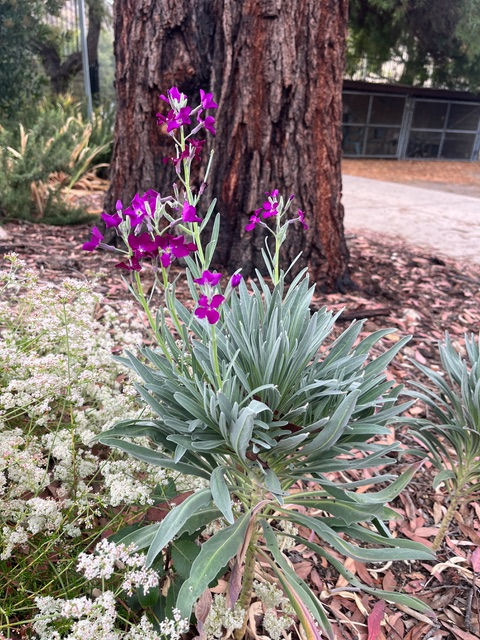
Multiple ID programs identified this beautiful plant as hoary stock (Matthiola incana). In our climate it can be a short-lived perennial. In cooler climates it is an annual or biennial. It is native to the Mediterranean area.
Thanks to Beverly, Daryl, Nancy and Janet for their images.
Enjoy the garden…KMM


