
Garden Activities; July 28, 2026

This Tuesday was another scorcher! But, the Tuesday Crew was undeterred and accomplished a great deal. The group divided themselves into 2 sub groups. Group One consisting of Jim Cyr, Steve Davis, Daryl Stutley, Nancy Taylor Walker, Janet Wall and Anna Wiktor-Becker worked in the area of the water feature in the Bird Habitat. Group Two consisting of Julia Appelrouth, Krystyna Bacik, Susanna Mac, Katie Shank and Ann Wright worked in the native section near the old Garden Entrance. I had a conflicting appointment so didn’t join the crew.
Work for Group One dovetailed with the demolition of the existing water feature. Today was the beginning of this year’s capital improvement project in which the existing waterfall and pond will be replaced by a more natural waterfall leading to a pondless water feature that should reduce maintenance and water use but still provide wildlife a source of water. Since they would be torn up and discarded, Steve decided to dig up some of the rushes and sedges for replanting along the edges of the new waterfall area.


This image makes it fairly clear the difference between a rush and a sedge. The rush stem in cross section is round or oval where the sedge stem is triangular. Here the sedge is in the foreground at right and the rush is the taller plant behind.
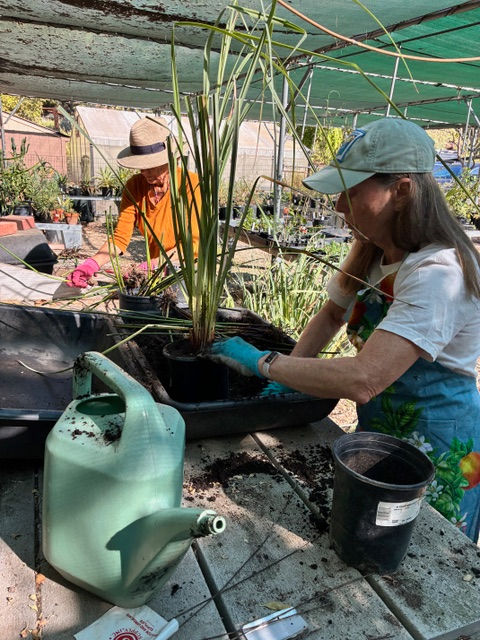
Once collected, the plugs were taken to the propagation shade house and potted up in gallon pots.


Meanwhile down by the old entrance Group Two was addressing unsightly deciduous stems of matilija poppies and making sure none were encroaching on the island natives planted there.

Notice the green watering can in the cart. An indication that this is the area where the irrigation system doesn’t quite reach the top of the slope, so plants there require occasional watering by hand.


Finally the plant of interest this week is the Lily of the Nile variety Agapanthus ’Storm Cloud.'

For those of us familiar with the common white or light blue varieties, there are interesting cultivars such as the one illustrated that have striking dark blue-violet blossoms. They are not as large or robust as their cousins and don’t seem to spread as much. If you want more of them, the seeds are viable but unreliable in generating plants with the same deep color in their blossoms as their parent. Better to propagate by dividing clumps.
Many thanks to Steve, Susanna, Katie, Nancy and Janet for their images.
Enjoy the garden….KMM


