
Garden Activities: August 4, 2026

Tuesday started out with a good bye celebration for Julia Appelrouth whose last day was today, Tuesday. She’s heading for a job in grants administration. Present for the sendoff were: Krystyna Bacik, Steve Davis, Susanna Mac, Katie Shank, Daryl Stutley, Nancy Taylor Walker, Marna Wensil, Ann Wright, and myself. Krystyna had made two coffee cakes - one chocolate; the other fruit and nuts - to share with the group. They were delicious!

Be careful of its close relative: tuberous sword fern (Nephrolepis cordifolia) which looks the same as Boston fern above ground, but has small distinct potato-like water storage structures below ground; it can spread rapidly. I learned it the hard way in my garden.
While we were finishing up our pieces of cake, Steve outlined a project he wanted help on. This included sourcing plants with which we can backfill the construction area around the new water feature in the Bird Habitat. One possible source would be in the vicinity of the water feature in the KAG from which we could take plant offshoots or plugs to get started in the shade house. Another source could be volunteer’s home gardens which could contain plants suitable for the area (e.g.the Boston fern from Steve's garden). If we ID desirable plants not found in the KAG or volunteer gardens, we’ll buy them.
So we all went up to the construction site to get a feel for the space to be occupied by the new feature and potential new plantings.

Work has been ongoing for a week, and yet to be determined are positioning of the path, if recreated, that used to go up one side, across the top (where we have a bench) and down the other side, and the coverage of the irrigation system.
So Steve peeled off with Katie, Marna and Julia to scout out the KAG for plants for the project.
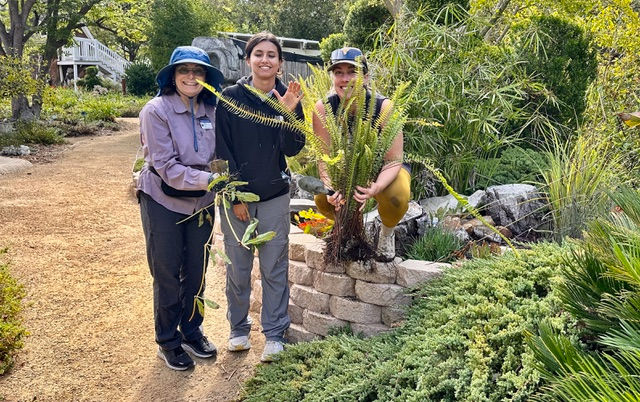
Marna is holding up yerba mansa (Anemopsis californica), a CA and more broadly a SW US and northern Mexico native. It likes its feet wet, so it will have to be very carefully positioned to receive frequent if not constant moisture from the water feature. Katie is holding up a Boston fern.
The rest of the group went up the first leg of the zig zag trail to the bed of bulbine on the right going up. There is frequently a judgement call around when to trim and deadhead. Two weeks ago, there were still some yellow flowers present at the ends of long flower stalks that were mostly lined with the remnants of dead flowers. This week, no yellow was present, and no seeds appeared to be present, so the decision was made for us. Deadhead.


We thought the job would take two weeks, but the twelve hands allowed us to finish the job in one.
Of interest this week are 2 plants, an animal and a physical feature.
Plant 1 is in the Australian Garden and is remarkable for its longevity and bloom.

Pink melaleuca (Melaleuca nesophila) is right next to the path so has been trimmed back severely more than once. Though difficult to make out, the blossoms are photographed against the backdrop of the plant’s trunk that is at least 8-10 inches in diameter. For a problematic area, this woody shrub to small tree is doing fine.
Plant 2 is between the bulbine patch and the 1st 4-corners.

Abelia ‘Edward Goucher’ (listed as ‘Henry Goucher’ in our database). This is a well-behaved shrub that blooms from summer to fall. It blooms best in full sun and when trimmed if needed in early spring before the new growth appears, as it blooms on new wood.
The animal:

It appears to be a banded garden spider. It is harmless and good for the garden as it consumes pests like flies, mosquitoes and other insects.
Finally, the gift that keeps on giving, the stone work in the Tranquility Garden. Always worth a trip to admire the artistry.

An unknown artist channelling Andrew Goldsworthy,
Many thanks to Steve, Daryl, Nancy and Susanna for their images.
Enjoy the garden! KMM


