
Garden Activities: June 2, 2026

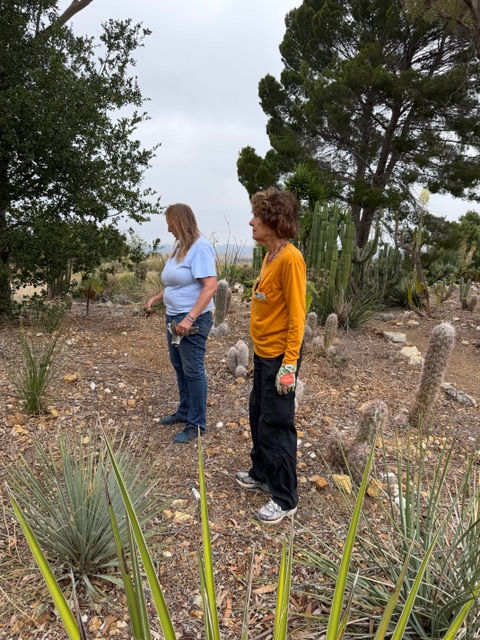
Volunteering Tuesday were: Julia Appelrouth, Dale Harshberger, Beverly Kemmerling, Katie Shank, Daryl Stutley and myself. We started off by completing Daryl’s project to remove the remaining 3 metal posts from the old fruit arbor which we took down to the service area and left with the other stakes against the wall between the garden and the condos.
From there, we made our way directly to the top of the hill where we discovered the various species of aloe needed some attention. At first, a cursory inspection of the aloe with yellow blossoms at the Desert Garden entrance revealed a few aloe mite galls which we quickly removed.

Once satisfied the visible galls had been removed from that aloe we examined the terrestrial aloes in the same area, and many had significant infestations of aloe mites. In that case, the galls couldn’t be just cut off, the whole plant was usually infested and had to be removed along with their infested pups if present.
The third task was to remove the spend bloom stalks of the other tall aloes which were old enough to remove by hand. If one is patient and can tolerate the dead blooms remaining on the pant for several weeks, the stalks will turn brown and naturally dehisce allowing them to be plucked out of the leaf axil or picked up from the ground if you’ve waited just a bit too long.

One of the plants that eveyone wanted to check out was the Joshua tree of which we have at least 2 in the Desert Garden. With climate change and habitat loss (both manmade and natural), the habitat for Joshua trees is changing, and their numbers are dwindling. The trees are extremely slow growing so I’ll be pushing 240 years old when they reach maturity (along with the saguaro cactus in my garden!)
And finally since I seem to be on a tear regarding prefixes, I’ll mention another one. Eve’s needle is the prickly cactus on the east side of the picnic benches. Its latin name is Austrocylindropuntia subulata. The “austro” referes to “southern” and indicates the plant is from S. America. “Cylindro” refers to the cylindrical nature of the stem to differentiate it from many others in the opuntia family which mostly have flat pad-like stems.

Thanks to Katie for creating the video recollection of May 2026 which is posted on the web page.
Thanks to Beverly for her images.
Enjoy the garden! KMM


