
Garden Activities: February 24, 2026
- Conejo Valley Botanic Garden

- Feb 28
- 3 min read
Tuesday was an unusual day for the Crew. Having walked the Nature Trail the day before, I was curious as to the crew’s familiarity with it. Turned out that most had either never walked the trail or if they had, it was some years ago. So, we took a break from the usual activity at this time of year (weeding/planting) and spent the morning slowly negotiating the Nature Trail. It was an opportunity to see some of the spring bloomers in flower that in a matter of days or at most weeks will have gone by. We started off from Entrance B of the trail and discussed the Sage Hill project, one of Beverly Brune’s many signature accomplishments: converting a whole hillside from invasive mustard to native chaparral plants. On the tour were: Beverly Kemmerling, Dale Harshberger, Hannah Nicole Lovett, Julie Moffat, Katie Shank, Daryl Stutley, Nancy Taylor Walker, Janet Wall, Anna Wiktor-Becker, Ann Wright and myself.
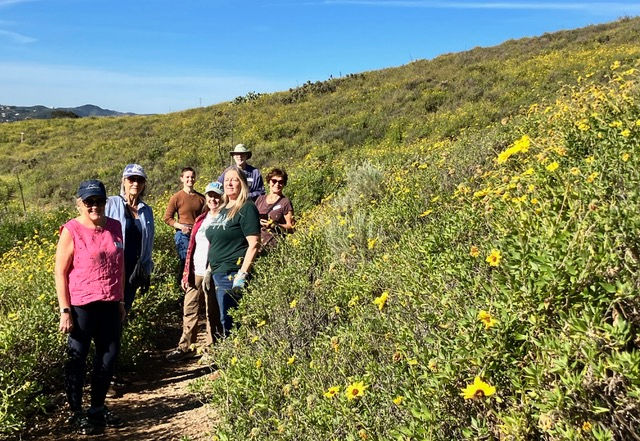
We discussed how the area is living up to Beverly’s vision that the geometric design of triangles and circles would naturalize into a self sustaining chaparral ecosystem. The main plant which covers the area with a sea of yellow at this time of year is brittlebush; also present are bladder pods, purple sage, scattered oaks, elderberries, white sage, yuccas and cacti.
When we reached the north side of the Nature Trail we saw some of the plants that don’t appear in the cultivated garden, including the native sections. These include:


These were all growing in a small area on the north side of the hill in full sun, and I’m not aware of them anywhere else in the garden.
One thing we discovered was a very specific pest that attacks the young buds on coyote brush.

The coyote brush bud gall midge is a fly that lays its eggs on the growing tips of the plant; the developing larvae use the resultant gall as food and protection from its’ insect enemies (parasitic wasps, e.g.). There are several of these growths in the garden.
In this area too was a downed limb obstructing the path that we will see if we can address next week.
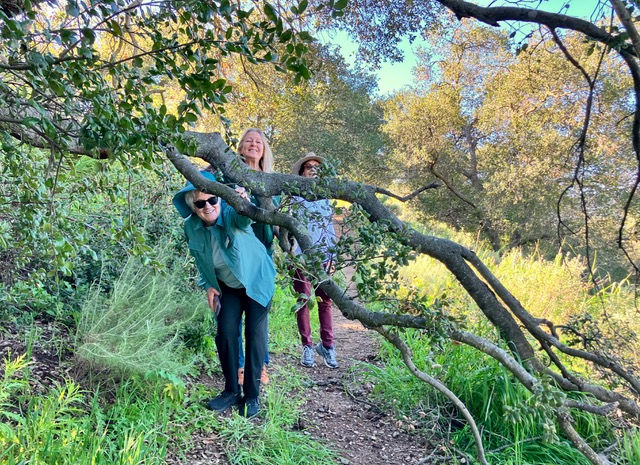

On the riparian leg of the trail, we saw a number of other unique (to our garden) flora including:

Toward the end of the tour we stopped at the mossy dripping rock, and I recounted the comment from a COSCA (Conejo Open Space Conservation Agency) representative who indicated that this geologic feature was unique in Ventura county. The year-round moisture comes from an underground spring in the adjacent park.


Finally Hannah and I (mostly Hannah!) dragged down a limb that the recent storm blew off from a small bottlebrush tree near Entrance B of the Nature Trail.

Thanks to Nancy, Beverly, Janet and Ann for their images!
Enjoy the garden…..KMM


Comments